

Following a glimpse of global harmony courtesy of Pokemon Go, it's beyond doubt that the creature-catching franchise stands as one of the most mainstream gaming titles in existence. The iconic Pikachu is every bit as identifiable as Disney's mascot, if not more so. The continued frenzy around card prices guarantees near-daily Pokemon headlines. You'd be difficult to find a pocket monster game that didn't sell at least a couple million copies. Even, unofficial Pokémon games achieve popularity every year.
However in spite of that pervasiveness and popularity, there are still Pokémon games that remain overlooked. These are games that failed to receive their fair shake, or were buried by the excitement of the mainline series. They're Pokémon games stuck on doomed platforms or services, or were pioneering attempts onto new mediums. They're often also Pokémon games that probably would have flourished if they had received follow-ups or contemporary re-releases. Considering these factors, we won't be offering just one more recommendation for Pokemon Conquest or the Pokémon Mystery Dungeon series. We're pulling an Excadrill.
Still, these might be these Pokémon games. Therefore, prior to adjusting your spectacles and typing 'Well,' we can all acknowledge that these are Pokémon games for those possessing refined tastes, agreed?
Pokémon Ranch: The Chill Precursor
An excessive number of Pokémon games emphasize the battling aspect of the series, and far too few of them focus on the ordinary aspects that would come with living with a companion. Sure, modern titles include small features like these in modern games—you can play with your monsters in bases. However, I'm longing for a Pokémon game more in the style of Nintendogs or The Sims.
My Pokemon Ranch (2008) for the Nintendo Wii isn't it. The downloadable-only title is most accurately viewed as the precursor to Pokemon Home; that is, as a repository to store monsters from different games. Reviews from its launch said Ranch was a bad if not truly ugly game. I'm not here to argue against these notions, but it compels me to say Ranch might be the closest we've come to a everyday life Pokémon game.
True to its title, the game is set on a farm where your Mii avatars—get this—just relax with your Pokémon pals. The interactions with Pokémon were basic, and a lot of the draw was observing what your monsters might do when not forced into cockfighting. Ideally, Pokémon Ranch would have been the start of a wonderful franchise built on the daily joys of coexisting with a tiny companion. However, because The Pokémon Company can collect a fee for Pokémon Home now, I'm guessing we will not get a Pokémon Ranch game realized to its fullest potential. I'd say 'save us, Pokémon Pokopia!' but I also know that the Nintendo Switch 2 exclusive is as much a puzzler as it is a life simulation.
Ranch was released long before Stardew Valley kicked off the enduring trend of cozy games. It was prior to the rise of passive games, and the Let's Play normalization of viewing games you aren't actively controlling. Many never realized that Ranch's concept to watch your critters as much as you play with them didn't mask a shallow core. In truth, Ranch's attention to detail was so extraordinary, there's a Twitch stream focused on running the game continuously. The individual who operates the channel states that, after almost twenty years of experiencing the game, he even now has not seen everything that is in it. Recognition for Pokémon Ranch: nobody understood you in 2008.
Pokemon Duel: The Tactical Board Game Lost
Did you know that Pokémon once had an official tabletop game with miniatures? Pokémon Duel was the 2016 attempt to adapt the physical experience in a more approachable format. Duel was also, sadly, one of Pokémon's first ventures into the world of freemium phone games. Duel had the trappings of a gacha game where players could pay to win—and there was motivation to do so, given the lengthy grind for new pieces.
All of these poor design choices masked a tragic reality: Pokémon Duel was an superb strategy game with Duel anymore. "I can’t express how much I adored and miss this game," a YouTube comment reads, years after Duel's servers were shut down. "Honestly I think this game was superior to TCG Pocket in terms of depth, accessibility, game design, and content in general," another commenter declared. "I truly believe if it came out now people would be engaging with it more than GO and Pocket combined."
Unfortunately, Duel's early release was plagued with connectivity problems. Technical problems, alongside Duel's predatory monetization model, gave people few incentives to come back. Should a revival occur, The Pokémon Company decided to revive this franchise, it's unclear things would end better. The unique board structure made for a fantastic strategic challenge for the few folks who played Duel, but that playing field is also a intimidating visual mess.
Pokemon: Magikarp Jump: The Silly Experiment
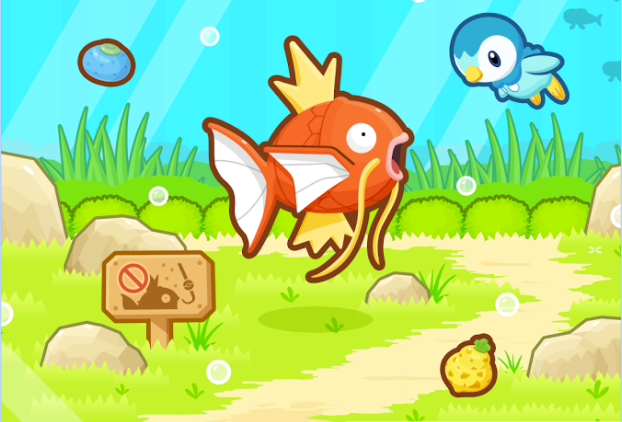
Man, why don't more Pokémon games loosen up a little and have some enjoyment? Magikarp Jump (2017) was a rare instance of The Pokémon Company giving its blessing a game with a premise so absurd, it was bordering on internet meme. And when we're dealing with a franchise where trainers go out with a team of useless monsters who literally can't do anything, it's surprising we don't have more Pokémon games that poke fun at themselves.
In Magikarp Jump, the player is tasked with raising the best possible version of the infamous fish. I'm not talking about a Magikarp that can win battles. These are 'karp raised to enter competitions to see who can flop the highest. One drawback is how Magikarp Jump, like many phone games, forces the player to pause before they can improve their Magikarp further. But it is clear throughout the experience that the developers appreciated and got the fan culture around Magikarp.
Nowhere was this more evident than in Jump's merciless random events, where your Magikarp was just as likely to raise its stats as it was to get eaten by a Pidgeotto. Beyond the clever dialogue, Magikarp Jump also experimented with other things one might wish the core series would do, like offering a wide variety of the same species of monster. I know it's not practical for any Pokémon game to have 30 different variations for a roster of over a thousand creatures, as Magikarp Jump does... but we can hope.
Magikarp Jump was not a particularly complex or profound game, but the kernels of genius were there. Sharply written events with outrageous outcomes that permanently influence how you can train a companion also describe the excellent Mewgenics. It's worth noting: Mewgenics will likely be in the conversation when Game of the Year season rolls around.
With numerous core games and derivative titles, chances are that I omitted that particular Pokémon game you totally love but contend that not nearly enough people played. I know that some people remember games like Pokémon Ranger or Pokemon Pinball fondly notwithstanding argu

